


A steep learning curve: how Spedition Stickel is building its battery-electric truck ecosystem
A few years ago, when Christian Stickel’s daughter asked him what he was doing for the environment, the company boss was at a loss for an answer. The next question followed quickly: why wasn’t he operating a photovoltaic system on his company premises? “At the time, it didn’t make economic sense,” recalls the managing partner of Spedition Stickel, based in Nagold near Stuttgart. However, his daughter’s persistence and, later, the energy crisis fundamentally changed his perspective on sustainability.
Today, the Baden-Württemberg-based Spedition Stickel is one of the pioneers in the use of battery-electric trucks among Germany’s medium-sized haulage firms – and is even participating in a recently launched real-world laboratory for grid-supportive electric truck charging by NetzeBW. Stickel now operates ten battery-electric vehicles daily, though their procurement required significant lead time. Initial discussions with energy provider EnBW took place as early as 2020. At the time, the advice was still to wait, as the technology was considered too expensive for a medium-sized company with around 100 employees, a fleet of 69 trucks, and an annual turnover of €15 million euros. “When the state of Baden-Württemberg later introduced funding programmes for charging infrastructure and vehicles, the situation changed,” explains the entrepreneur.
A successful funding bid
Stickel and his team began with detailed planning, analysing peak loads, developing a power supply concept, and ultimately applying for funding for ten battery-electric trucks. They succeeded: for the installation of charging infrastructure on their premises, Stickel received grants totalling around €240,000 euros, according to the company. The state also funded the purchase of the electric trucks, with the company receiving between €75,000 and €85,000 euros per vehicle. The haulage firm deliberately opted against a cautious start with a single vehicle. “We wanted to implement a large-scale solution to assess organisational processes, driving profiles, and economic viability more quickly than with a single test vehicle,” explains the managing director.
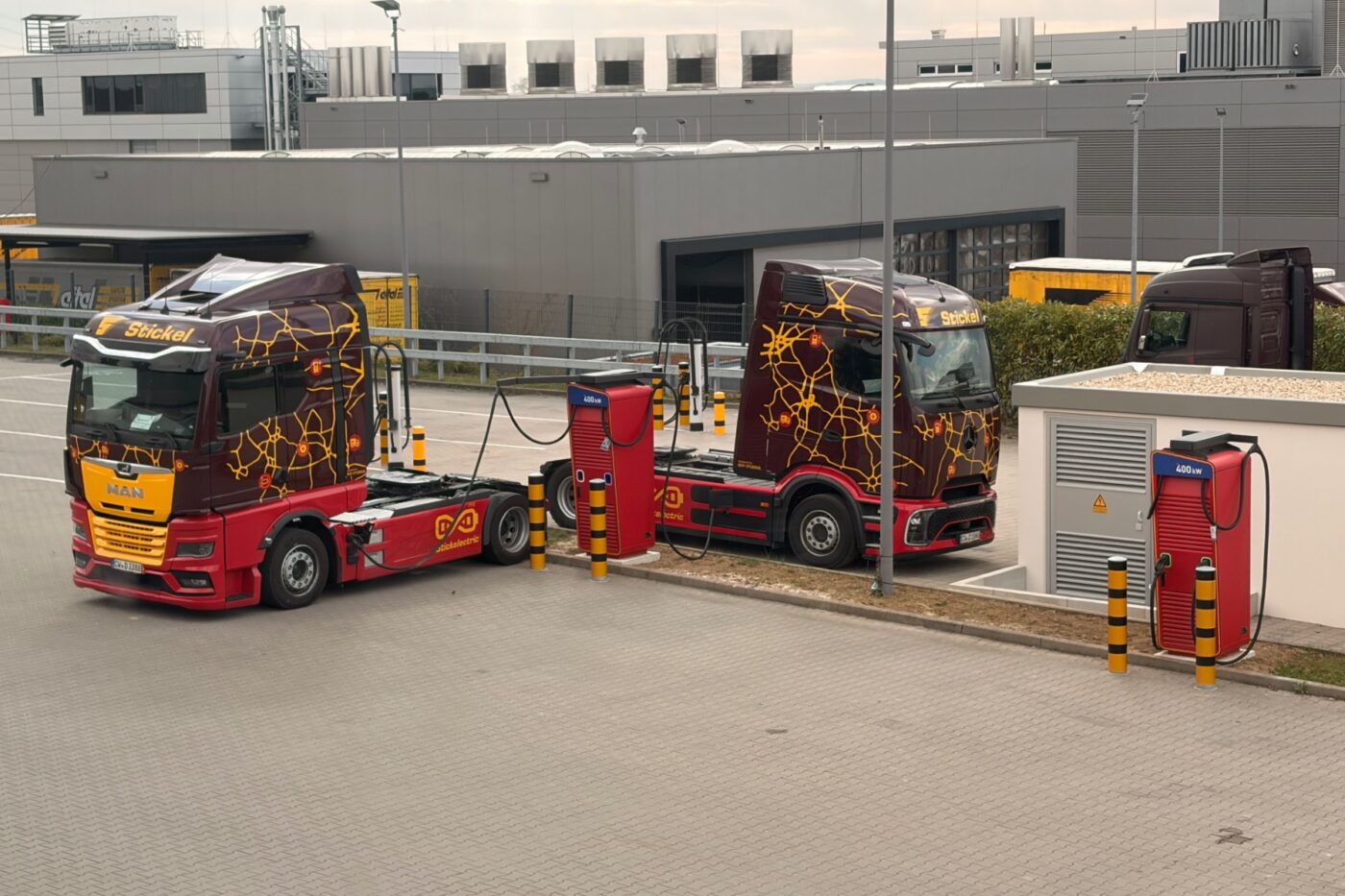
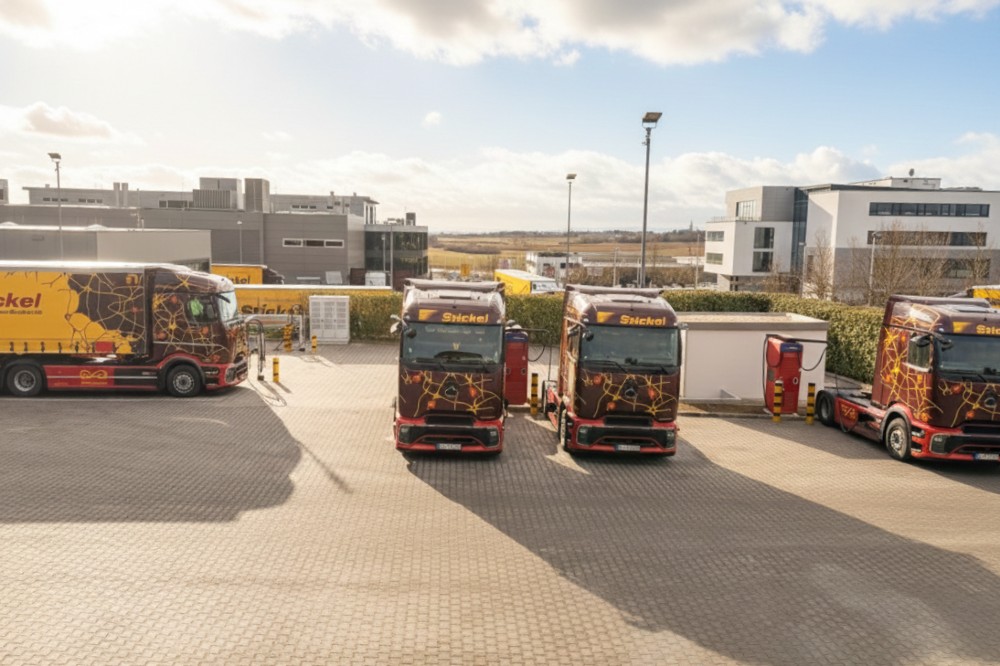
At the end of 2024, the first six electric Mercedes eActros 600 trucks entered service, followed a few months later by four MAN eTGX models. Behind a dedicated 1,000kW transformer, there are currently four fast-charging stations with a total of eight charging points: two Alpitronic chargers, each with up to 400kW capacity, whose power can be flexibly split, and a system from manufacturer Kempower, which can be expanded by a further six charging points. An intelligent load management system controls the power flows and distributes the available grid capacity across the trucks.
Battery-electric truck secures new contract
In addition to their own sustainability goals, customer requirements played a key role in the decision to purchase commercial EVs. The haulage company works for automotive manufacturers and suppliers such as Mercedes-Benz, Porsche, and Bosch. “Tenders increasingly included requirements for low-emission transport,” reports Stickel. For one client, the planned use of battery-electric trucks even became a prerequisite for collaboration. Decarbonising the supply chain is thus increasingly becoming a competitive factor for logistics service providers.
Stickel now deploys its vehicles in both regional transport and longer-distance routes. After gaining initial experience in local operations, the company gradually expanded its MAN eTGX Ultra-Lowliners to routes such as Düsseldorf, Bremen, and Bayreuth. Charging is carried out en route at fast-charging hubs with up to 400kW capacity. The legally mandated driver breaks can often be combined with charging times. While planning is more complex than with diesel operations, the journeys now function reliably in practice.
One thing is clear: battery-electric vehicles are still significantly more expensive than conventionally powered trucks. However, Stickel expects that the entry of Chinese manufacturers into the price segment of €180,000 to €220,000 euros will significantly increase competitive pressure in Europe. This could force German manufacturers to adjust their prices, making vehicle prices of around €150,000 euros achievable in the long term.
Significantly higher mileage
Furthermore, the managing director highlights the advantages of battery-electric trucks in terms of maintenance requirements and service life. Based on his experience, the economic service life of diesel trucks typically ranges between 600,000 and 800,000km, depending on the operating profile, mileage, and loads transported. For battery-electric trucks, he refers to manufacturer specifications, which state that the batteries are designed for a mileage of up to 1.2 million km or around 1,800 charging cycles. “Although these figures are not intended to be fully utilised in practice, they indicate a significantly longer service life,” he says.
A key success factor, independent of this, is driver acceptance. Initially, some persuasion was needed to get drivers accustomed to the new battery-electric trucks. “But once someone has driven an electric vehicle, they don’t want to switch back to a combustion engine,” reports the entrepreneur. Drivers particularly appreciate the quieter and more relaxed driving experience, as well as the high torque for overtaking on hills. “There is already high demand for our eleventh battery-electric truck, which will arrive shortly,” he emphasises.
From an economic perspective, depot charging remains the key to the cost-effective operation of the electric fleet. At its premises, Stickel already relies on photovoltaics and is currently planning further expansion. A new logistics hall with 6,000 sq. metres of floor space, scheduled to commence operations at the end of February 2027, will be equipped with a photovoltaic system with around 650 kilowatt-peak (kWp) capacity. This will be supplemented by a battery storage system with a capacity of four megawatt-hours. The company aims to become less dependent on fluctuating diesel and electricity prices and to cover a large portion of its energy needs itself. In the future, Stickel plans to open its charging hub, with up to 1.6 megawatts of charging capacity, to third parties.
Thorough preparation is essential
Stickel also emphasises that electrification involves far more than simply purchasing new vehicles. In his view, the complexity is often underestimated. “In addition to the charging infrastructure, several IT systems are required to integrate load and energy management with billing.” The integration of photovoltaics, battery storage, vehicle data, and charging planning is equally challenging and still feels like true pioneering work. Collaboration with customers is also crucial, he notes. In daily operations, technical issues or delays can occur, which are not uncommon with new technologies. “Therefore, clients must support this transformation process and be willing to pay more,” stresses the haulier. At the same time, there needs to be an understanding that electromobility is still undergoing learning curves in many areas.
As the most important recommendation for other companies, Stickel therefore advises thorough preparation. Those investing in commercial electric vehicles must consider charging infrastructure, energy supply, and IT from the outset. Equally important is the early involvement of drivers, dispatch teams, and customers. “For us, there is no turning back. We are continuing down this path—consistently and decisively,” says Stickel. For him, it is clear that battery-electric trucks will be the central technology in road freight transport in the long term—even if some challenges still need to be overcome.
0 Comments