


Mars and Rewe deploy 47 battery-electric trucks on pilot corridor
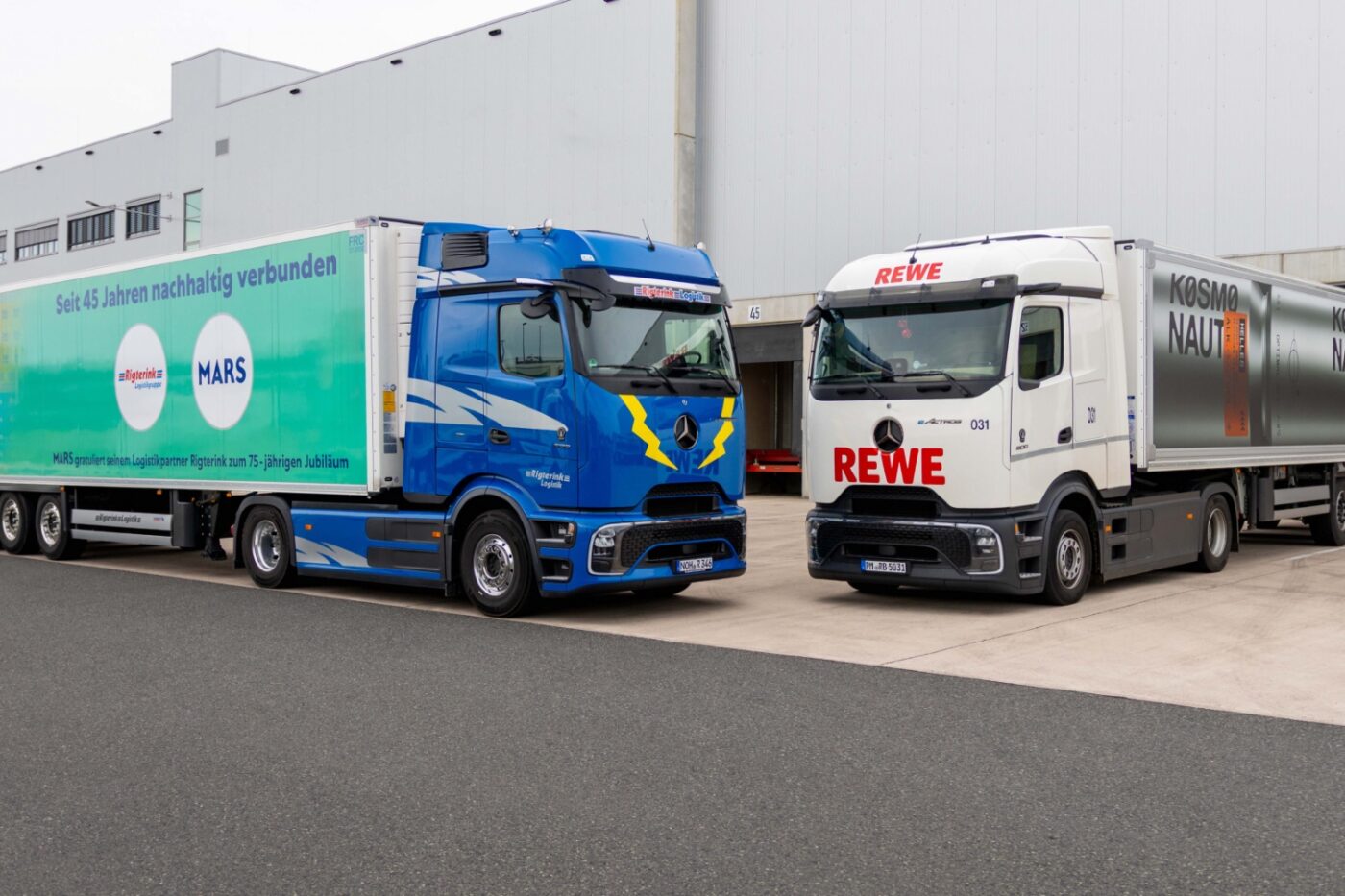
Mars and Rewe are closely collaborating to establish a cross-border, end-to-end corridor for the zero-emission transport of food products using a total of 47 battery-electric trucks. “On defined routes, products from Mars’s business segments—snacks, pet food, and food – are transported electrically from production or storage facilities via the REWE logistics centre directly to REWE stores,” Mars stated in a German-language press release. The end-to-end corridor spans the Netherlands and Germany.
We have previously reported on Mars’s plans to electrify its logistics in these two countries, as well as Rewe’s similar ambitions. However, until now, both companies had “only electrified their own regional sub-routes”, as they describe it. The newly launched corridor, which ranges from production all the way to the point of sale, is set to take their electrification efforts to the next level.
In practice, it means Mars products are now transported by battery-electric truck from chocolate factories in the Dutch town of Veghel and Viersen in North Rhine-Westphalia – as well as from a pet food factory in Verden, Lower Saxony – to Mars’s logistics centre in Minden, in North Rhine-Westphalia. From there, the goods continue to Rewe’s central warehouse in Oranienburg, Brandenburg, and subsequently via electric trucks to over 300 REWE stores and a REWE delivery service warehouse, where electric vehicles are also in use.
Project demonstrates “operational feasibility”
In this joint network, Mars currently operates 23 battery-electric trucks, while Rewe deploys 24, totalling the 47 vehicles mentioned earlier. Since Mars and Rewe began using electric trucks on their respective sub-routes, the partners report having logged over 2.4 million electric kilometres, saved around 750,000 litres of diesel, and avoided nearly 2,600 tonnes of CO₂e (well-to-wheel). These statistics include Mars’s electric truck activities from January 2024 to April 2026 and Rewe’s from January 2025 to April 2026.
For Mars, the newly launched corridor project demonstrates “the operational feasibility of a complete end-to-end route under real-world conditions.” At the same time, it highlights existing challenges and provides “reliable insights for future scaling.” While the electric truck delivery routes are still highly optimisable, continuous exchange between the partners helps address challenges and successfully overcome initial setbacks, Mars noted.
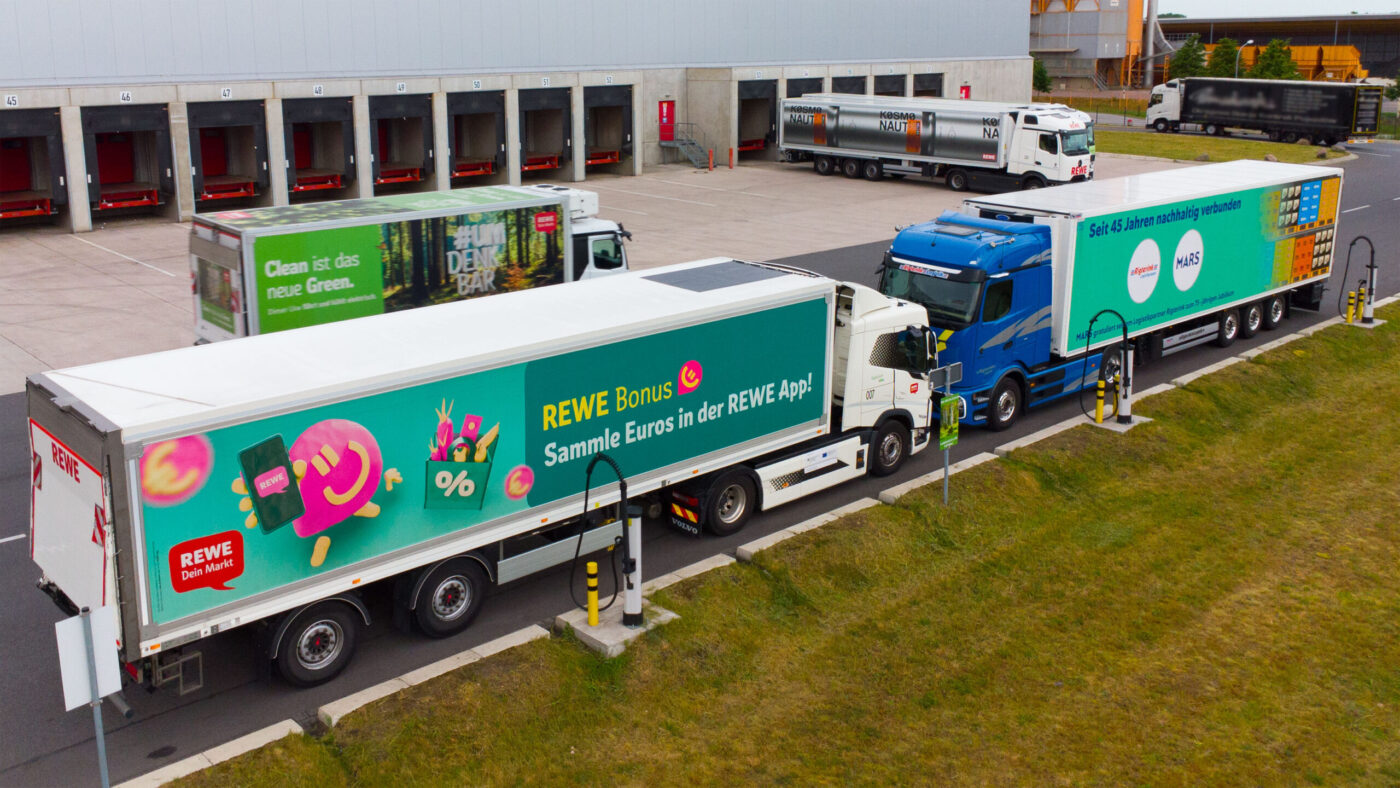
What is clear: decisionmakers at both companies consider electrified road freight transport to be “ecologically sound, operationally well-integrable, and economically viable,” despite the ecosystems not yet being fully mature. In addition to the environmental and economic benefits, they highlight further advantages of the technology, such as the reduced noise levels of the trucks -particularly beneficial for urban store deliveries – and improved driver comfort.
“Volatility of diesel prices will remain high”
Lars Siebel, Executive Director of Logistics/SCM at the Rewe Group, commented: “Our message to all hauliers and truck fleet operators is to conduct a business case analysis for adopting e-mobility. The volatility of diesel prices will remain high due to geopolitical uncertainties. In comparison, electricity prices are stable and are expected to become even more affordable in the future. Already today, more than half of the routes in our network are cheaper to operate and maintain with a battery-electric truck than with a diesel vehicle. With optimised route planning, this cost advantage can be further increased, accelerating the amortisation of the higher upfront costs of electric trucks.”
Björn Schlenker, Supply Chain Integration Director at Mars Europe, adds: “This best practice can be transferred to other electrifiable end-to-end routes, including cross-border ones. A resilient network setup reduces emissions across transport logistics and directly contributes to cost structures, delivery capability, and service quality.”
Mars, incidentally, has set an ambition for the company to have 300 electric trucks on Europe’s roads by 2030. The company first announced this target in early 2024 and reaffirmed it in a statement from early 2026 regarding the integration of five Mercedes-Benz eActros 600 trucks for Mars’ logistics partner, Rigterink. With this future fleet of 300 electric trucks, Mars aims to reduce annual CO₂ emissions in its European logistics by approximately ten per cent. This initiative is part of Mars’s global commitment to halve its greenhouse gas emissions (Scope 1 to 3) by 2030, using 2015 as the baseline year.
Mars first deployed electric trucks in Germany in early 2024. At that time, the company began electrifying its transport route between Verden and Minden. For this, partner Einride provided Mars with two Mercedes-Benz eActros 300 trucks, two charging stations, and its operating system, Saga. In October 2025, six additional eActros 600 trucks were introduced to German and Dutch roads (DE) as part of the Einride-Mars collaboration. These trucks have since been shuttling between Mars’s factories in Viersen and Veghel and the warehouse in Minden. These projects represent the aforementioned sub-routes preceding the new pilot corridor.
The German Mars subsidiary is part of the US-based Mars Incorporated, a global manufacturer of branded goods operating in over 70 countries. In 2024, Mars Germany generated a turnover of over €2 billion euros. The company employs around 5,900 staff across more than 90 operational sites for its business segments: Mars Wrigley, Mars Pet Nutrition, Royal Canin, and Mars Food & Nutrition. Some of the company’s most well-known brands include Miracoli, Snickers, Kitekat, and Airwaves.
mars.com (DE)


0 Comments